> ## Documentation Index
> Fetch the complete documentation index at: https://docs.atomicagi.com/llms.txt
> Use this file to discover all available pages before exploring further.
# Questions
> Review question-shaped queries so you can find informational demand and decide which answers need better coverage
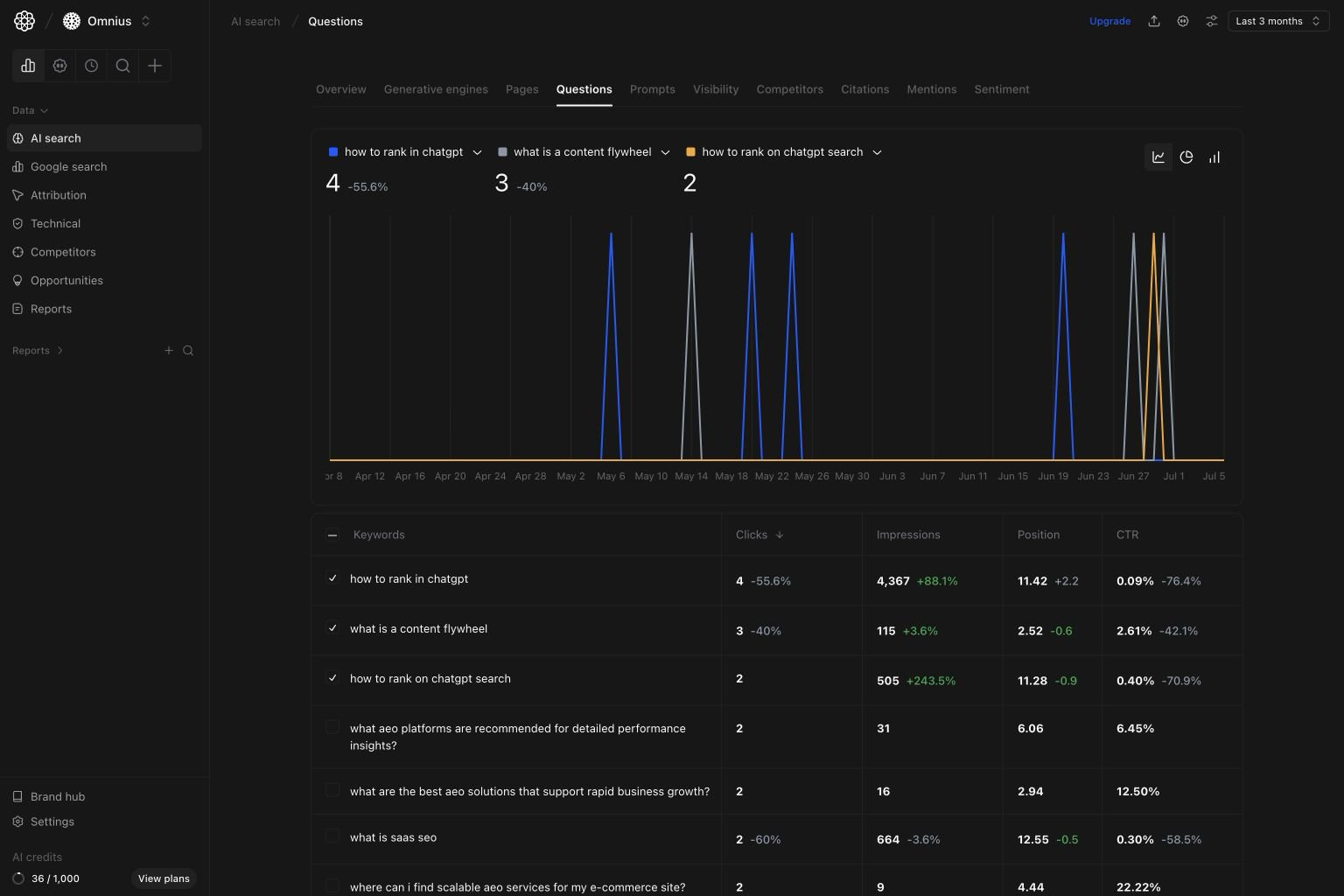 Use this page to review question-style search demand in one place. It helps you decide which educational or comparison questions deserve new content, better answers, or clearer page targeting.
## Questions this page should answer
1. Which questions are already bringing visits?
2. Which question patterns are rising or falling?
3. Which pages should answer those questions better?
## Before you analyze
* Keep the date range aligned with your other search reports.
* Start with broad question themes before drilling into single queries.
* Compare performance with landing pages before changing content.
## What this page gives you
* A table of question-style queries.
* Click, impression, CTR, and position context for those questions.
* Direct drill-down from a question to the related landing pages.
## How to read the top question trend
Use the chart to spot movement before opening individual rows.
* The selected question chips show the questions currently plotted.
* `Clicks` shows whether the question is already producing visits.
* `Impressions` shows whether demand exists even when clicks are weak.
* `Position` shows whether the page is close enough to improve with focused work.
* `CTR` shows whether the current result earns attention.
Use this rule:
* High impressions + low CTR usually means the answer snippet or page framing is weak.
* Rising clicks on repeated themes can justify a new section, FAQ, or comparison page.
* Poor position on high-intent questions usually needs stronger page relevance and links.
## How these metrics are calculated (simple)
```text theme={null}
Question row = search query classified as question-style intent
```
```text theme={null}
CTR = clicks / impressions
```
Position is the average ranking position for that query during the selected date range.
## How to use this page
### Start with repeated themes
Group similar questions together first. Repeated wording around pricing, alternatives, setup, or trust usually points to a missing section or missing page, not just one weak keyword.
### Separate education from decision intent
Some questions need early-funnel explainer content. Others need stronger product pages, comparison pages, or FAQ sections on existing money pages.
### Validate with page-level context
If a question has impressions but weak clicks, check whether the matching page title and description answer the question clearly enough.
## Quick weekly checklist
1. Flag the top rising question cluster.
2. Flag the top declining question cluster.
3. Check which landing pages are responsible for those movements.
4. Turn one high-intent cluster into a content or refresh task.
## What to fix first
| Pattern in Questions data | What it usually means | Recommended action |
| --------------------------- | ------------------------------------------- | ----------------------------------------------------- |
| High impressions, low CTR | Result does not answer the question clearly | Rewrite title, intro, or FAQ answer |
| Good clicks, poor position | Demand exists but page authority is weak | Improve relevance and add internal links |
| Many similar questions rise | Searchers need a dedicated answer pattern | Add a FAQ section or create a focused page |
| Question has buying intent | Commercial page may need clearer comparison | Add proof, pricing, alternatives, or decision content |
| One-off question spikes | Could be temporary noise | Watch before assigning major content work |
## Team routine
1. Weekly: group repeated question patterns.
2. Bi-weekly: refresh the highest-intent page tied to question demand.
3. Monthly: compare question movement with landing page and prompt performance.
## Keep in mind
* A single question rarely matters by itself. Patterns matter more.
* Question demand often reveals missing comparison, FAQ, or trust content.
* Do not rewrite pages until the same question theme appears often enough to matter.
## Where to go next
* [Google Search overview](/data/google-search/overview)
* [Keywords](/data/google-search/keywords)
* [Landing pages](/data/google-search/landing-pages)
* [Prompts](/data/ai-search/prompts)
Use this page to review question-style search demand in one place. It helps you decide which educational or comparison questions deserve new content, better answers, or clearer page targeting.
## Questions this page should answer
1. Which questions are already bringing visits?
2. Which question patterns are rising or falling?
3. Which pages should answer those questions better?
## Before you analyze
* Keep the date range aligned with your other search reports.
* Start with broad question themes before drilling into single queries.
* Compare performance with landing pages before changing content.
## What this page gives you
* A table of question-style queries.
* Click, impression, CTR, and position context for those questions.
* Direct drill-down from a question to the related landing pages.
## How to read the top question trend
Use the chart to spot movement before opening individual rows.
* The selected question chips show the questions currently plotted.
* `Clicks` shows whether the question is already producing visits.
* `Impressions` shows whether demand exists even when clicks are weak.
* `Position` shows whether the page is close enough to improve with focused work.
* `CTR` shows whether the current result earns attention.
Use this rule:
* High impressions + low CTR usually means the answer snippet or page framing is weak.
* Rising clicks on repeated themes can justify a new section, FAQ, or comparison page.
* Poor position on high-intent questions usually needs stronger page relevance and links.
## How these metrics are calculated (simple)
```text theme={null}
Question row = search query classified as question-style intent
```
```text theme={null}
CTR = clicks / impressions
```
Position is the average ranking position for that query during the selected date range.
## How to use this page
### Start with repeated themes
Group similar questions together first. Repeated wording around pricing, alternatives, setup, or trust usually points to a missing section or missing page, not just one weak keyword.
### Separate education from decision intent
Some questions need early-funnel explainer content. Others need stronger product pages, comparison pages, or FAQ sections on existing money pages.
### Validate with page-level context
If a question has impressions but weak clicks, check whether the matching page title and description answer the question clearly enough.
## Quick weekly checklist
1. Flag the top rising question cluster.
2. Flag the top declining question cluster.
3. Check which landing pages are responsible for those movements.
4. Turn one high-intent cluster into a content or refresh task.
## What to fix first
| Pattern in Questions data | What it usually means | Recommended action |
| --------------------------- | ------------------------------------------- | ----------------------------------------------------- |
| High impressions, low CTR | Result does not answer the question clearly | Rewrite title, intro, or FAQ answer |
| Good clicks, poor position | Demand exists but page authority is weak | Improve relevance and add internal links |
| Many similar questions rise | Searchers need a dedicated answer pattern | Add a FAQ section or create a focused page |
| Question has buying intent | Commercial page may need clearer comparison | Add proof, pricing, alternatives, or decision content |
| One-off question spikes | Could be temporary noise | Watch before assigning major content work |
## Team routine
1. Weekly: group repeated question patterns.
2. Bi-weekly: refresh the highest-intent page tied to question demand.
3. Monthly: compare question movement with landing page and prompt performance.
## Keep in mind
* A single question rarely matters by itself. Patterns matter more.
* Question demand often reveals missing comparison, FAQ, or trust content.
* Do not rewrite pages until the same question theme appears often enough to matter.
## Where to go next
* [Google Search overview](/data/google-search/overview)
* [Keywords](/data/google-search/keywords)
* [Landing pages](/data/google-search/landing-pages)
* [Prompts](/data/ai-search/prompts)