> ## Documentation Index
> Fetch the complete documentation index at: https://docs.atomicagi.com/llms.txt
> Use this file to discover all available pages before exploring further.
# Competitor AI Search Visibility
> Compare competitor visibility against citation volume so you can spot who is gaining answer share fastest
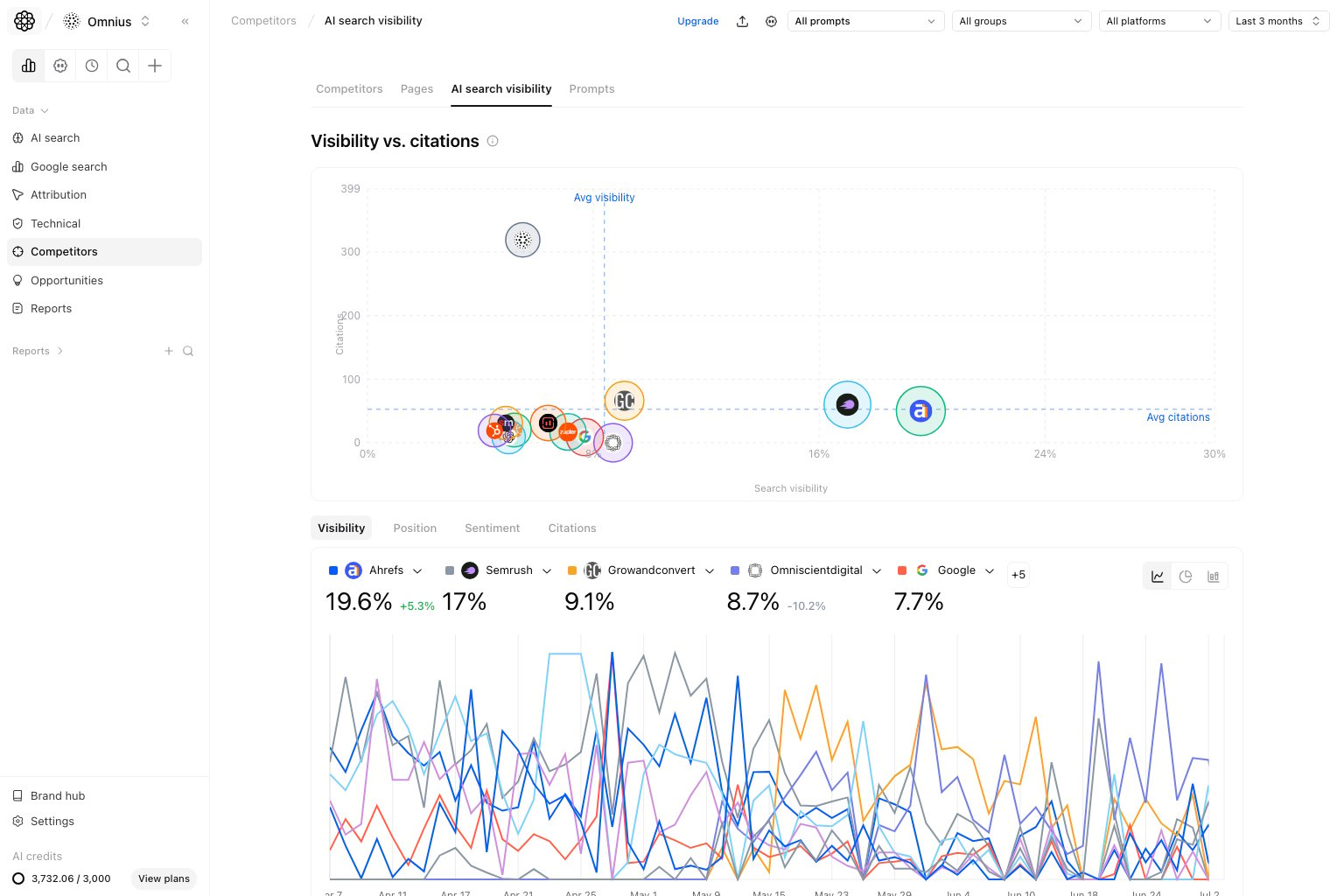 Use this page to compare competitor visibility in AI answers. It helps you understand who is appearing most often and whether that visibility is backed by stronger citation coverage.
## Questions this page should answer
1. Which competitors own the most AI search visibility?
2. Which competitors combine visibility with strong citations?
3. Which brands are rising fast enough to require a response?
## Before you analyze
* Keep the date range aligned with AI Search Visibility and Citations.
* Focus on the top competitor set first.
* Separate confirmed visibility shifts from speculation about why they happened.
## What this page gives you
* Competitor visibility rows.
* A visibility-versus-citations comparison view.
* Supporting metrics such as position and sentiment when available.
## How to read the visibility chart
Read visibility and citation strength together before deciding what to fix.
* `Visibility`: how often a competitor appears in AI-search answer surfaces.
* `Citations`: how often sources connected to that competitor are cited.
* `Position`: how prominently the competitor appears when it is present.
* `Sentiment`: whether the surrounding answer context is positive, neutral, or negative.
Use this rule:
* High visibility + high citations usually indicates durable authority.
* High visibility + low citations can be a fragile or temporary gain.
* Low visibility + high citations may indicate authority that is not turning into answer share.
## How these metrics are calculated (simple)
```text theme={null}
Visibility = competitor presence across tracked AI-search answer observations
```
```text theme={null}
Citation volume = cited source count associated with competitor visibility
```
Position and sentiment summarize how the competitor appears when present, not why the movement happened.
## How to use this page
### Read visibility and citations together
High visibility with weak citation support can be fragile. High visibility with strong citation support usually indicates a more durable advantage.
### Look for emerging risers
You do not need the market leader to be the biggest immediate risk. A smaller competitor with fast movement often deserves the faster response.
### Use it to choose the next comparison work
When a competitor is gaining here, validate the pages, prompts, and proof patterns behind the move before changing your own content.
## Quick weekly checklist
1. Review the top visibility gainers.
2. Compare each gainer with citation strength.
3. Open related competitor prompts for repeated losses.
4. Check competitor pages for content or proof patterns.
5. Assign one recovery action for the highest-risk competitor movement.
## How to use filters
* Keep the date range aligned with [AI Search visibility](/data/ai-search/visibility).
* Filter by competitor when one brand is moving unusually fast.
* Use prompt/topic filters when visibility changes are tied to one theme.
## What to fix first
| Pattern in competitor visibility | What it usually means | Recommended action |
| --------------------------------------------- | --------------------------------------- | --------------------------------------------------- |
| Competitor visibility rises quickly | They are gaining answer share | Review their prompts, pages, and citations together |
| Competitor has high citations and rank | Their authority signal is strong | Strengthen proof, sources, and comparison content |
| Competitor visibility rises, citations do not | Narrative may be driving the gain | Improve page framing and answer-ready summaries |
| Your brand loses on buying prompts | Commercial pages may be under-supported | Refresh product, comparison, and proof pages |
| Sentiment shifts negative | Answer context may be harming trust | Review source quality and update corrective content |
## Team routine
1. Weekly: check top risers and top losses.
2. Bi-weekly: connect competitor movement to prompt and page fixes.
3. Monthly: report which competitor actions changed visibility or citations.
## Keep in mind
* Visibility alone does not explain the reason for the gain.
* Citation strength often explains whether a competitor advantage is temporary or durable.
* Use the top risers to decide where prompt and content review should start.
## Where to go next
* [Competitors overview](/data/competitors/overview)
* [Competitor prompts](/data/competitors/prompts)
* [AI Search visibility](/data/ai-search/visibility)
* [Citations](/data/ai-search/citations)
Use this page to compare competitor visibility in AI answers. It helps you understand who is appearing most often and whether that visibility is backed by stronger citation coverage.
## Questions this page should answer
1. Which competitors own the most AI search visibility?
2. Which competitors combine visibility with strong citations?
3. Which brands are rising fast enough to require a response?
## Before you analyze
* Keep the date range aligned with AI Search Visibility and Citations.
* Focus on the top competitor set first.
* Separate confirmed visibility shifts from speculation about why they happened.
## What this page gives you
* Competitor visibility rows.
* A visibility-versus-citations comparison view.
* Supporting metrics such as position and sentiment when available.
## How to read the visibility chart
Read visibility and citation strength together before deciding what to fix.
* `Visibility`: how often a competitor appears in AI-search answer surfaces.
* `Citations`: how often sources connected to that competitor are cited.
* `Position`: how prominently the competitor appears when it is present.
* `Sentiment`: whether the surrounding answer context is positive, neutral, or negative.
Use this rule:
* High visibility + high citations usually indicates durable authority.
* High visibility + low citations can be a fragile or temporary gain.
* Low visibility + high citations may indicate authority that is not turning into answer share.
## How these metrics are calculated (simple)
```text theme={null}
Visibility = competitor presence across tracked AI-search answer observations
```
```text theme={null}
Citation volume = cited source count associated with competitor visibility
```
Position and sentiment summarize how the competitor appears when present, not why the movement happened.
## How to use this page
### Read visibility and citations together
High visibility with weak citation support can be fragile. High visibility with strong citation support usually indicates a more durable advantage.
### Look for emerging risers
You do not need the market leader to be the biggest immediate risk. A smaller competitor with fast movement often deserves the faster response.
### Use it to choose the next comparison work
When a competitor is gaining here, validate the pages, prompts, and proof patterns behind the move before changing your own content.
## Quick weekly checklist
1. Review the top visibility gainers.
2. Compare each gainer with citation strength.
3. Open related competitor prompts for repeated losses.
4. Check competitor pages for content or proof patterns.
5. Assign one recovery action for the highest-risk competitor movement.
## How to use filters
* Keep the date range aligned with [AI Search visibility](/data/ai-search/visibility).
* Filter by competitor when one brand is moving unusually fast.
* Use prompt/topic filters when visibility changes are tied to one theme.
## What to fix first
| Pattern in competitor visibility | What it usually means | Recommended action |
| --------------------------------------------- | --------------------------------------- | --------------------------------------------------- |
| Competitor visibility rises quickly | They are gaining answer share | Review their prompts, pages, and citations together |
| Competitor has high citations and rank | Their authority signal is strong | Strengthen proof, sources, and comparison content |
| Competitor visibility rises, citations do not | Narrative may be driving the gain | Improve page framing and answer-ready summaries |
| Your brand loses on buying prompts | Commercial pages may be under-supported | Refresh product, comparison, and proof pages |
| Sentiment shifts negative | Answer context may be harming trust | Review source quality and update corrective content |
## Team routine
1. Weekly: check top risers and top losses.
2. Bi-weekly: connect competitor movement to prompt and page fixes.
3. Monthly: report which competitor actions changed visibility or citations.
## Keep in mind
* Visibility alone does not explain the reason for the gain.
* Citation strength often explains whether a competitor advantage is temporary or durable.
* Use the top risers to decide where prompt and content review should start.
## Where to go next
* [Competitors overview](/data/competitors/overview)
* [Competitor prompts](/data/competitors/prompts)
* [AI Search visibility](/data/ai-search/visibility)
* [Citations](/data/ai-search/citations)