> ## Documentation Index
> Fetch the complete documentation index at: https://docs.atomicagi.com/llms.txt
> Use this file to discover all available pages before exploring further.
# Content gaps
> Compare competitor pages, topic clusters, and repeated URL patterns.
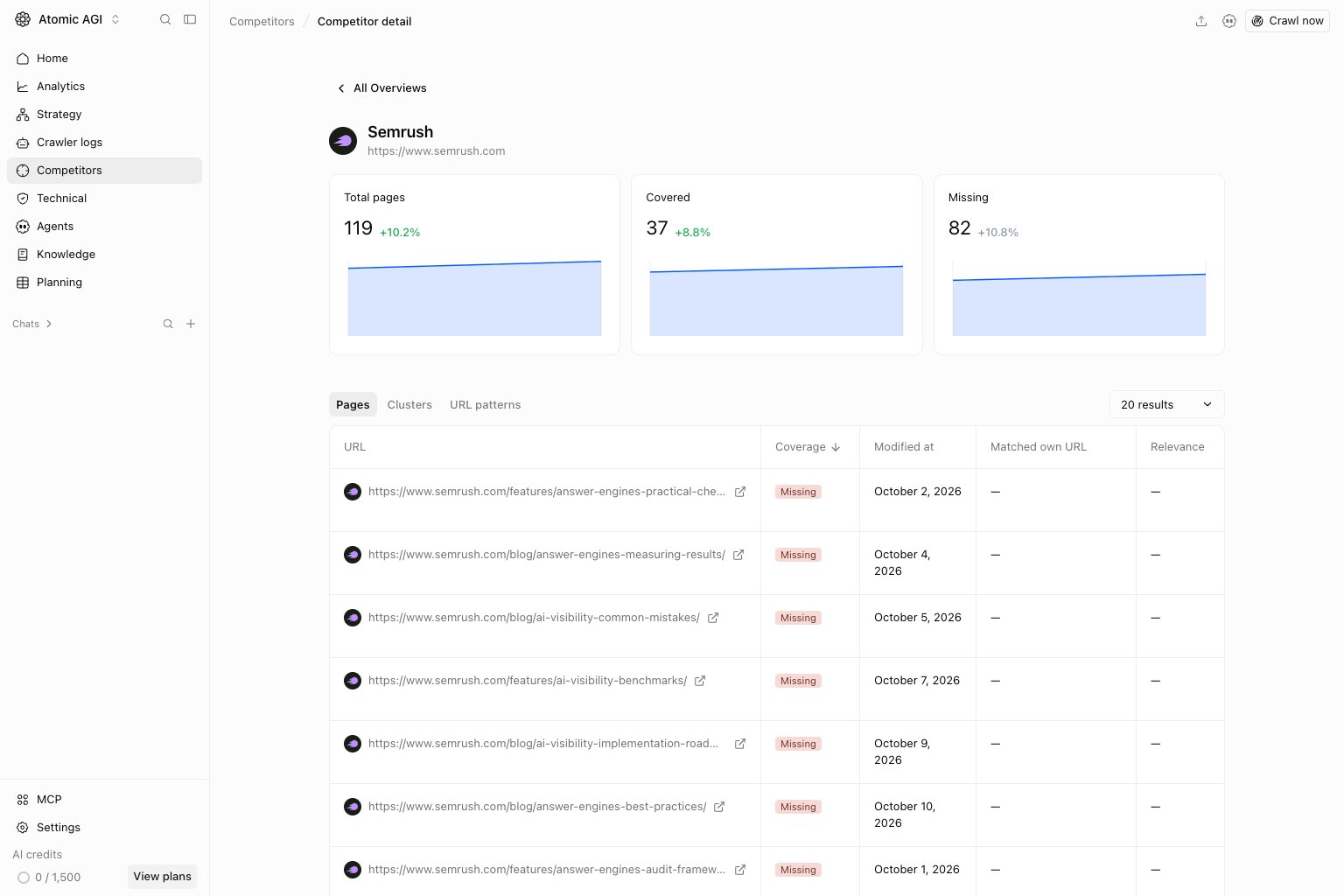
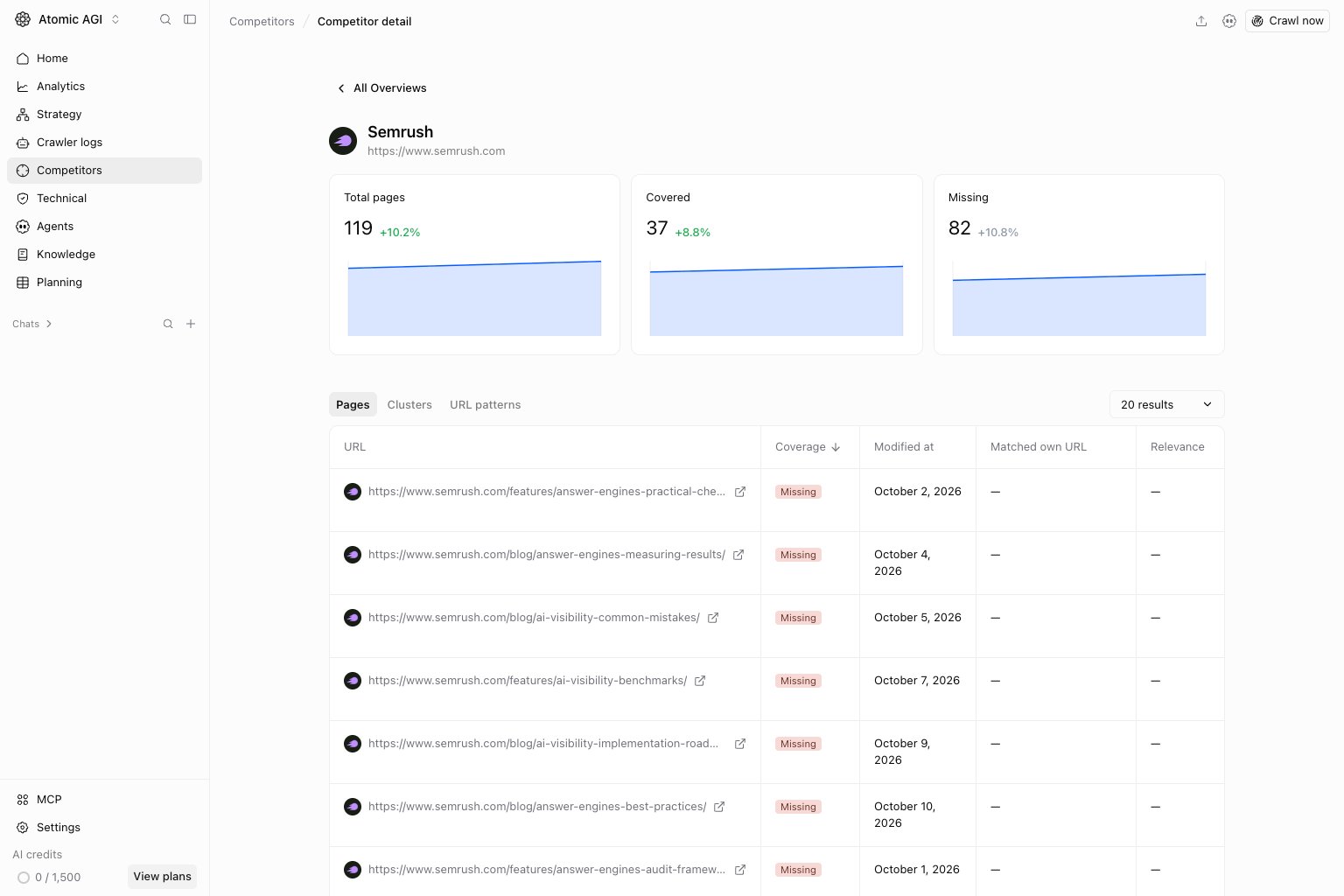 Screenshots use Semrush as the example competitor, with an illustrative inventory of 119 pages. Page URLs, classifications, coverage, and metrics are sample data, not a live audit of Semrush.
Open **Competitors → Overview** to review tracked sites and inspect their content gaps. Select a competitor to explore the pages behind its coverage. Review crawl and classification readiness before interpreting missing results.
## Read coverage summaries
Pages describes the current inventory. Covered and Missing describe classification against your content. Unclassified pages still need evidence; they should not automatically enter the missing-content backlog. Redirects and removed URLs also need different treatment from live content.
## Pages tab
Compare individual URLs, page category/type, intent, cluster, funnel, and coverage where available. Open the page to check its purpose before deciding to create or update content. Use the results-per-page control for a manageable review batch.
Screenshots use Semrush as the example competitor, with an illustrative inventory of 119 pages. Page URLs, classifications, coverage, and metrics are sample data, not a live audit of Semrush.
Open **Competitors → Overview** to review tracked sites and inspect their content gaps. Select a competitor to explore the pages behind its coverage. Review crawl and classification readiness before interpreting missing results.
## Read coverage summaries
Pages describes the current inventory. Covered and Missing describe classification against your content. Unclassified pages still need evidence; they should not automatically enter the missing-content backlog. Redirects and removed URLs also need different treatment from live content.
## Pages tab
Compare individual URLs, page category/type, intent, cluster, funnel, and coverage where available. Open the page to check its purpose before deciding to create or update content. Use the results-per-page control for a manageable review batch.
 ## Clusters tab
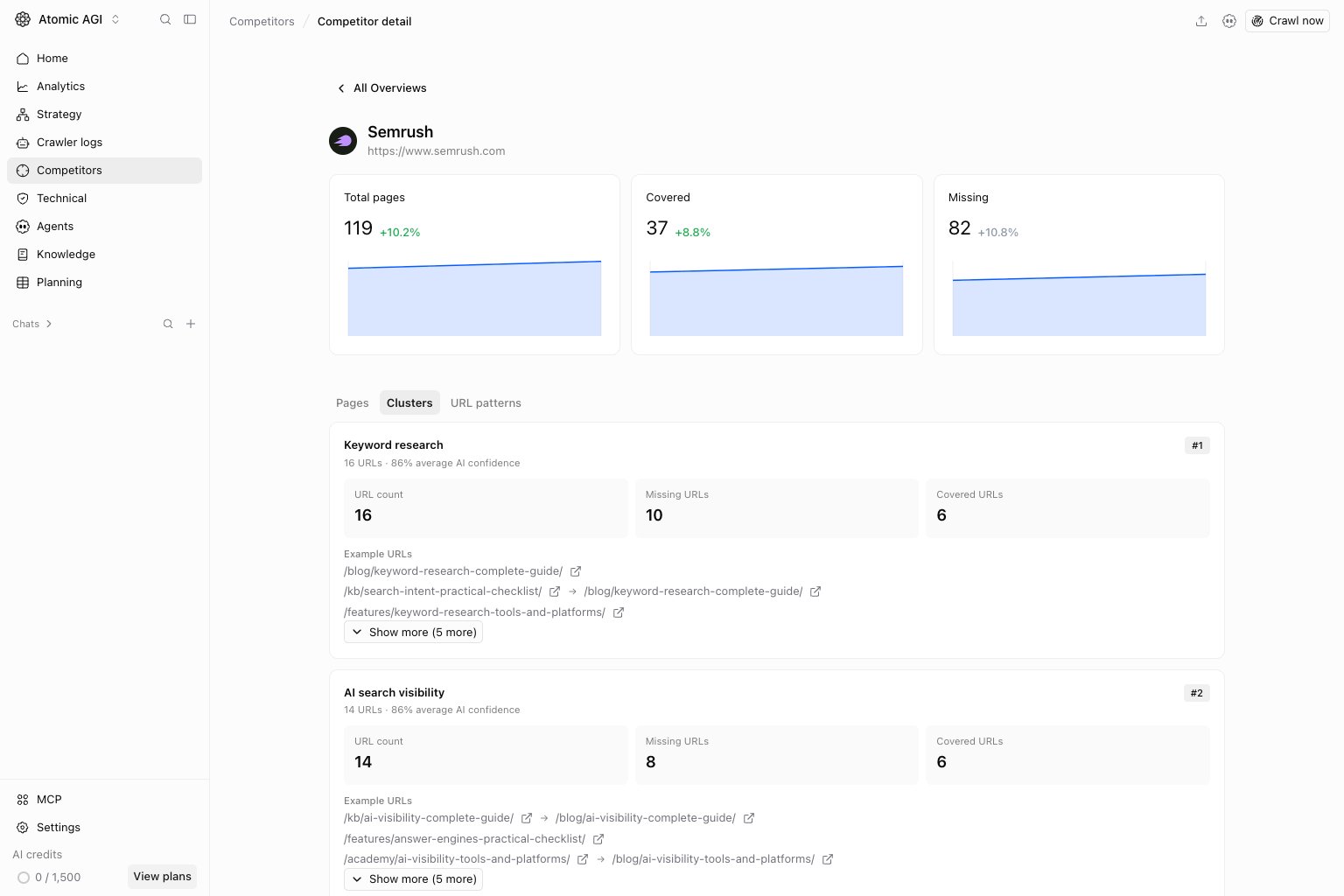
Group pages by topic to find repeated gaps. Review representative pages and how the cluster supports your audience before adding an entire topic to the plan. Low-confidence classification is a signal to inspect the source.
## Clusters tab
Group pages by topic to find repeated gaps. Review representative pages and how the cluster supports your audience before adding an entire topic to the plan. Low-confidence classification is a signal to inspect the source.
 ## URL patterns tab
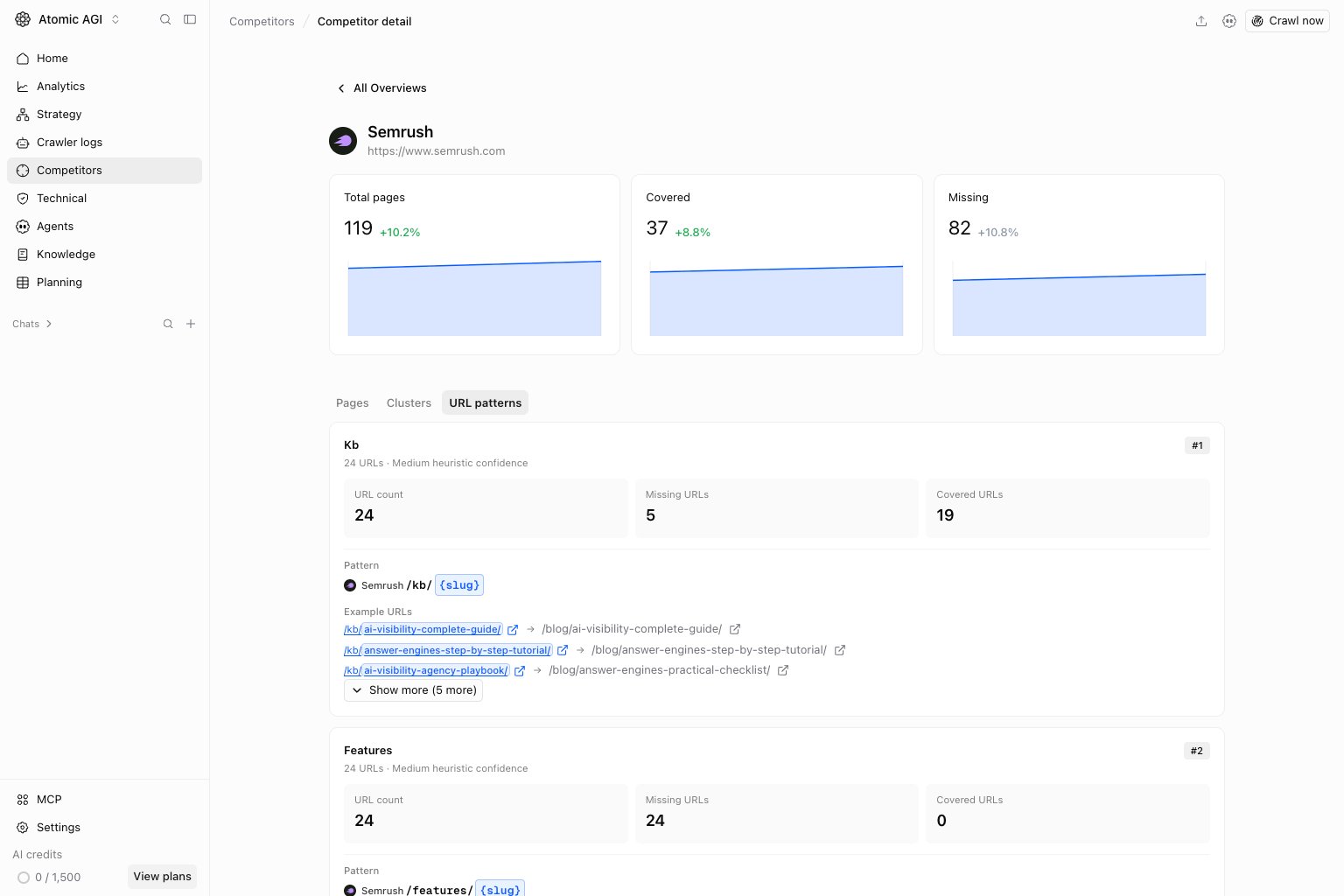
Use repeated URL structures to identify possible programmatic content formats. A URL pattern is a heuristic, not proof that all matching pages share a useful content model. Inspect the examples and the confidence label before starting programmatic research.
## URL patterns tab
Use repeated URL structures to identify possible programmatic content formats. A URL pattern is a heuristic, not proof that all matching pages share a useful content model. Inspect the examples and the confidence label before starting programmatic research.
 ## Where to go next
* [Competitor management](/data/competitors/overview)
* [Strategy pages](/strategy/pages)
* [Workflows](/automation/workflows/overview)
This documentation is built and hosted on [Mintlify](https://mintlify.com), a developer documentation platform.
## Where to go next
* [Competitor management](/data/competitors/overview)
* [Strategy pages](/strategy/pages)
* [Workflows](/automation/workflows/overview)
This documentation is built and hosted on [Mintlify](https://mintlify.com), a developer documentation platform.