> ## Documentation Index
> Fetch the complete documentation index at: https://docs.atomicagi.com/llms.txt
> Use this file to discover all available pages before exploring further.
# Geography
> Compare performance by market and region
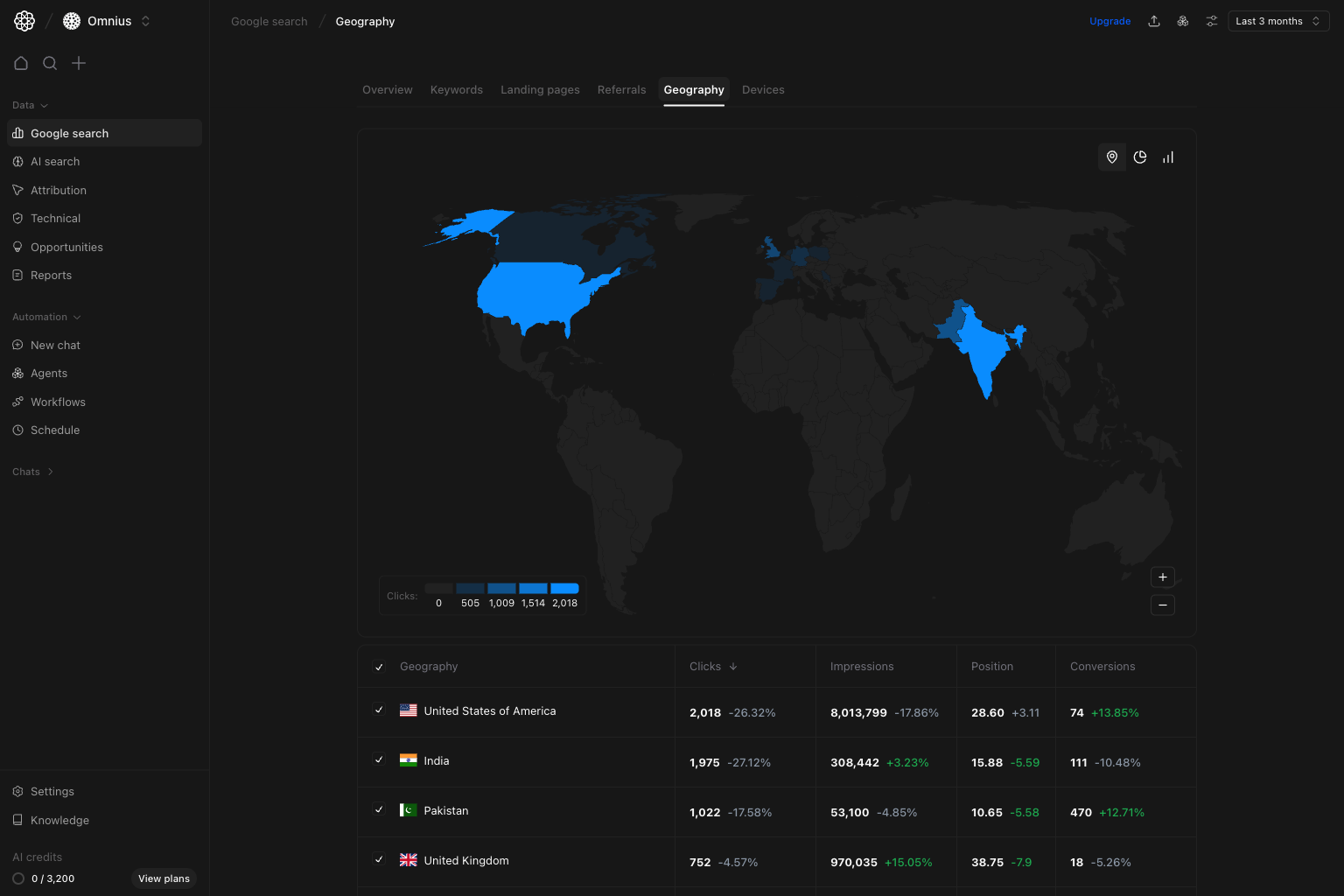 Use this page to make country-level SEO decisions with clear data. It helps you answer three key questions:
1. Which markets are driving growth or creating drag?
2. Where are impressions high but clicks weak?
3. Which countries deserve localized content or technical focus next?
## Before you analyze
* Use comparable date ranges before judging market movement.
* Start globally, then isolate one region at a time.
* Review both volume (`Clicks`, `Impressions`) and quality (`Position`, `Conversions`).
## What this page gives you
The Geography page combines:
* A world map heat layer to show click concentration by country.
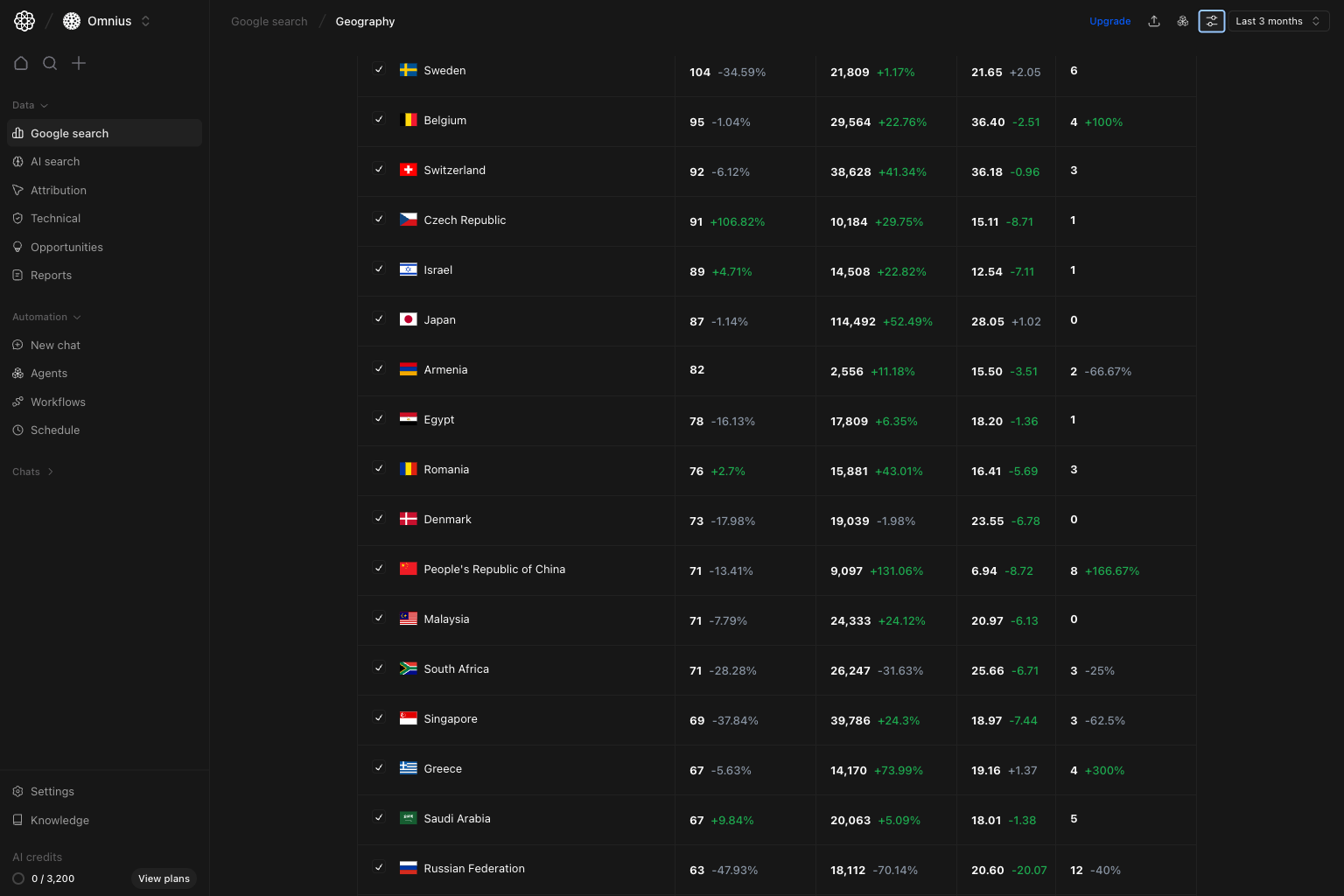
* A country table with `Clicks`, `Impressions`, `Position`, and `Conversions`.
* View toggles in the map area for different perspectives.
* Shared filters (`Keyword`, `Page`, `Device`, `Country`) for focused regional analysis.
## How to read geography metrics correctly
* `Clicks`: current traffic contribution by market.
* `Impressions`: search demand and visibility footprint in that country.
* `Position`: how strong your ranking is in local search.
* `Conversions`: helps you avoid over-prioritizing low-intent markets.
A market with lower clicks but strong conversions may deserve more investment than a high-volume market with weak outcomes.
## Quick weekly checklist
1. Start with map concentration.
Check if performance depends on a small number of countries.
2. Scan top-country table rows.
Find biggest movers in clicks and conversions first.
3. Check ranking efficiency by market.
Prioritize countries where position is improving but clicks lag.
4. Compare mature vs emerging markets.
Separate stabilization tasks from expansion experiments.
5. Convert findings into localized actions.
Assign language updates, regional content, and market-specific SEO tasks.
Use deeper rows to find mid-tier markets that can become your next growth layer.
Use this page to make country-level SEO decisions with clear data. It helps you answer three key questions:
1. Which markets are driving growth or creating drag?
2. Where are impressions high but clicks weak?
3. Which countries deserve localized content or technical focus next?
## Before you analyze
* Use comparable date ranges before judging market movement.
* Start globally, then isolate one region at a time.
* Review both volume (`Clicks`, `Impressions`) and quality (`Position`, `Conversions`).
## What this page gives you
The Geography page combines:
* A world map heat layer to show click concentration by country.
* A country table with `Clicks`, `Impressions`, `Position`, and `Conversions`.
* View toggles in the map area for different perspectives.
* Shared filters (`Keyword`, `Page`, `Device`, `Country`) for focused regional analysis.
## How to read geography metrics correctly
* `Clicks`: current traffic contribution by market.
* `Impressions`: search demand and visibility footprint in that country.
* `Position`: how strong your ranking is in local search.
* `Conversions`: helps you avoid over-prioritizing low-intent markets.
A market with lower clicks but strong conversions may deserve more investment than a high-volume market with weak outcomes.
## Quick weekly checklist
1. Start with map concentration.
Check if performance depends on a small number of countries.
2. Scan top-country table rows.
Find biggest movers in clicks and conversions first.
3. Check ranking efficiency by market.
Prioritize countries where position is improving but clicks lag.
4. Compare mature vs emerging markets.
Separate stabilization tasks from expansion experiments.
5. Convert findings into localized actions.
Assign language updates, regional content, and market-specific SEO tasks.
Use deeper rows to find mid-tier markets that can become your next growth layer.
 ## How to use filters
Use filters to test one country-specific idea before planning execution.
## How to use filters
Use filters to test one country-specific idea before planning execution.
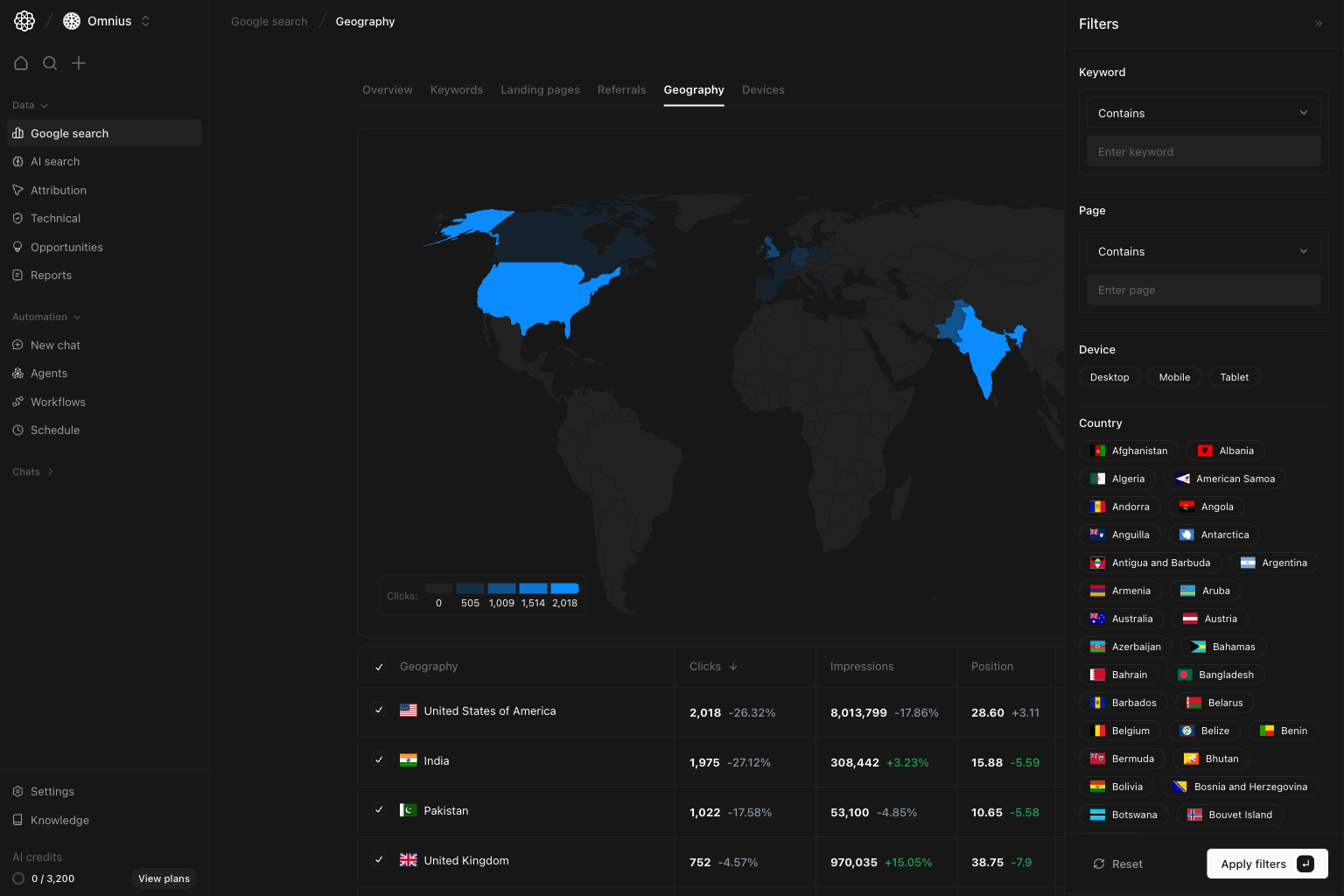 * `Country = [target market]`
Isolate one market to check local trend quality.
* `Page contains [/blog/ or /product/]`
Compare template performance by country intent.
* `Keyword contains [cluster term]`
Verify if a topic performs unevenly across markets.
* `Device = Mobile`
Detect regional mobile UX/ranking gaps.
## What to fix first
| Pattern in geography data | What it usually means | Recommended action |
| -------------------------------------------- | -------------------------------------------- | ----------------------------------------------------------- |
| High impressions, low clicks in one country | Local messaging does not match search intent | Localize titles/meta and improve local messaging |
| Clicks down, position worse in a key market | More competition or weaker market fit | Refresh localized pages and strengthen local internal links |
| Position improving, conversions flat | More visibility but weaker traffic quality | Adjust content intent and conversion path |
| Small market, strong conversion rate | High-quality niche opportunity | Expand targeted content and supporting pages |
| Large market, volatile week-to-week movement | Seasonality or campaign noise | Validate with longer windows before reallocating resources |
## Team routine
1. Weekly: identify largest country-level gains/losses and assign owners.
2. Bi-weekly: review conversion quality shifts in top markets.
3. Monthly: publish regional scorecard with localized action plan.
4. Quarterly: decide where to expand or reduce localization investment.
## Keep in mind
* Country-level averages can hide city-level differences.
* Position is an average and not a single tracked keyword rank.
* New market growth can be noisy; confirm persistence over multiple periods.
## Where to go next
* [Google Search overview](/data/google-search/overview): macro trend context
* [Keywords](/data/google-search/keywords): query-level differences by market
* [Landing pages](/data/google-search/landing-pages): URL-level market outcomes
* [Devices](/data/google-search/devices): mobile/desktop split by geography
* `Country = [target market]`
Isolate one market to check local trend quality.
* `Page contains [/blog/ or /product/]`
Compare template performance by country intent.
* `Keyword contains [cluster term]`
Verify if a topic performs unevenly across markets.
* `Device = Mobile`
Detect regional mobile UX/ranking gaps.
## What to fix first
| Pattern in geography data | What it usually means | Recommended action |
| -------------------------------------------- | -------------------------------------------- | ----------------------------------------------------------- |
| High impressions, low clicks in one country | Local messaging does not match search intent | Localize titles/meta and improve local messaging |
| Clicks down, position worse in a key market | More competition or weaker market fit | Refresh localized pages and strengthen local internal links |
| Position improving, conversions flat | More visibility but weaker traffic quality | Adjust content intent and conversion path |
| Small market, strong conversion rate | High-quality niche opportunity | Expand targeted content and supporting pages |
| Large market, volatile week-to-week movement | Seasonality or campaign noise | Validate with longer windows before reallocating resources |
## Team routine
1. Weekly: identify largest country-level gains/losses and assign owners.
2. Bi-weekly: review conversion quality shifts in top markets.
3. Monthly: publish regional scorecard with localized action plan.
4. Quarterly: decide where to expand or reduce localization investment.
## Keep in mind
* Country-level averages can hide city-level differences.
* Position is an average and not a single tracked keyword rank.
* New market growth can be noisy; confirm persistence over multiple periods.
## Where to go next
* [Google Search overview](/data/google-search/overview): macro trend context
* [Keywords](/data/google-search/keywords): query-level differences by market
* [Landing pages](/data/google-search/landing-pages): URL-level market outcomes
* [Devices](/data/google-search/devices): mobile/desktop split by geography