

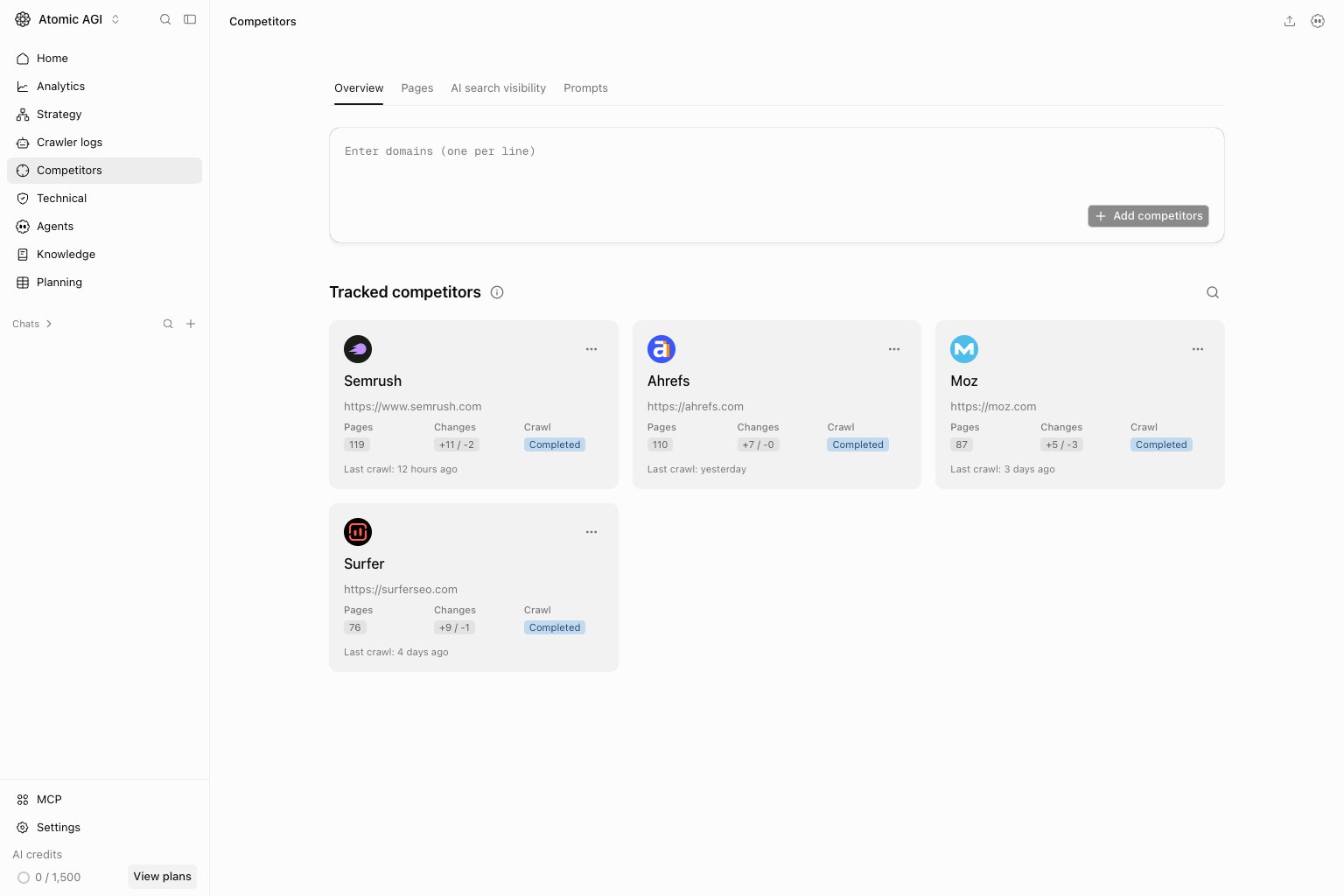
Questions this page should answer
- Which competitor domains are currently tracked?
- Which suggested competitors should we accept or dismiss?
- Which competitor crawls are ready, pending, or failed?
Before you manage competitors
- Keep the list focused on direct search competitors, not every adjacent brand.
- Add domains in batches when you are expanding into a new segment.
- Review crawl status before expecting data on the other competitor pages.
What this page gives you
- The accepted competitor list for the project.
- Suggested competitors you can accept or dismiss.
- Crawl status and crawl recency for each competitor.
- A form to add domains manually.
How to read the competitor list
Read this page as the source of truth for every downstream competitor report.Domain: the competitor Atomic will compare against your project.Status: whether the competitor crawl is ready, pending, or failed.Last crawled: how fresh the competitor page data is.Suggested competitors: candidate domains that still need review.
- If a competitor is not accepted here, do not expect it in competitor page or prompt analysis.
- If a competitor crawl is pending, wait before diagnosing missing downstream data.
- If a competitor is no longer strategically relevant, remove it before it pollutes comparisons.
How these statuses work (simple)
How to use this page
Keep the list narrow and intentional
Too many competitors create noisy page and prompt comparisons. Track the domains that compete for the same audience, SERP space, or AI answer share.Review suggestions before accepting
Suggested competitors save time, but they still need human judgment. Accept the domains that truly overlap with your offer and dismiss the rest.Watch crawl status
Pending or failed crawls explain missing downstream competitor data. Fix the tracked list first before assuming the analysis pages are wrong.Quick weekly checklist
- Review new suggested competitors.
- Accept only domains that compete for the same audience, SERP, or AI-answer space.
- Remove stale competitors that no longer match the strategy.
- Check crawl status before opening page-level or prompt-level competitor reports.
- Re-run downstream analysis after large competitor list changes.
How to use filters
- Filter by status when you need to find pending or failed crawls quickly.
- Search by domain when the competitor list is large.
- Review suggestions in batches so the accepted list stays intentional.
What to fix first
Team routine
- Weekly: review suggestions and crawl status.
- Bi-weekly: prune accepted competitors that no longer matter.
- Monthly: align the competitor set with campaign, market, and AI-search priorities.
Keep in mind
- This page controls the competitor set used by the other competitor views.
- New competitors may need time before page-level analysis becomes useful.
- A clean competitor list improves both prompt and content-gap decisions.