

Questions this page should answer
- Which competitors are strongest on our tracked prompts?
- Which prompt groups are we losing most often?
- Which prompt losses are worth fixing first?
Before you analyze
- Make sure your tracked prompts are current.
- Filter to one topic or prompt family at a time when diagnosing a loss.
- Pair prompt movement with citations before deciding the fix.
What this page gives you
- Prompt-level competitor comparisons.
- A way to isolate which brands lead on each tracked question.
- Clear input for content, proof, and authority decisions.
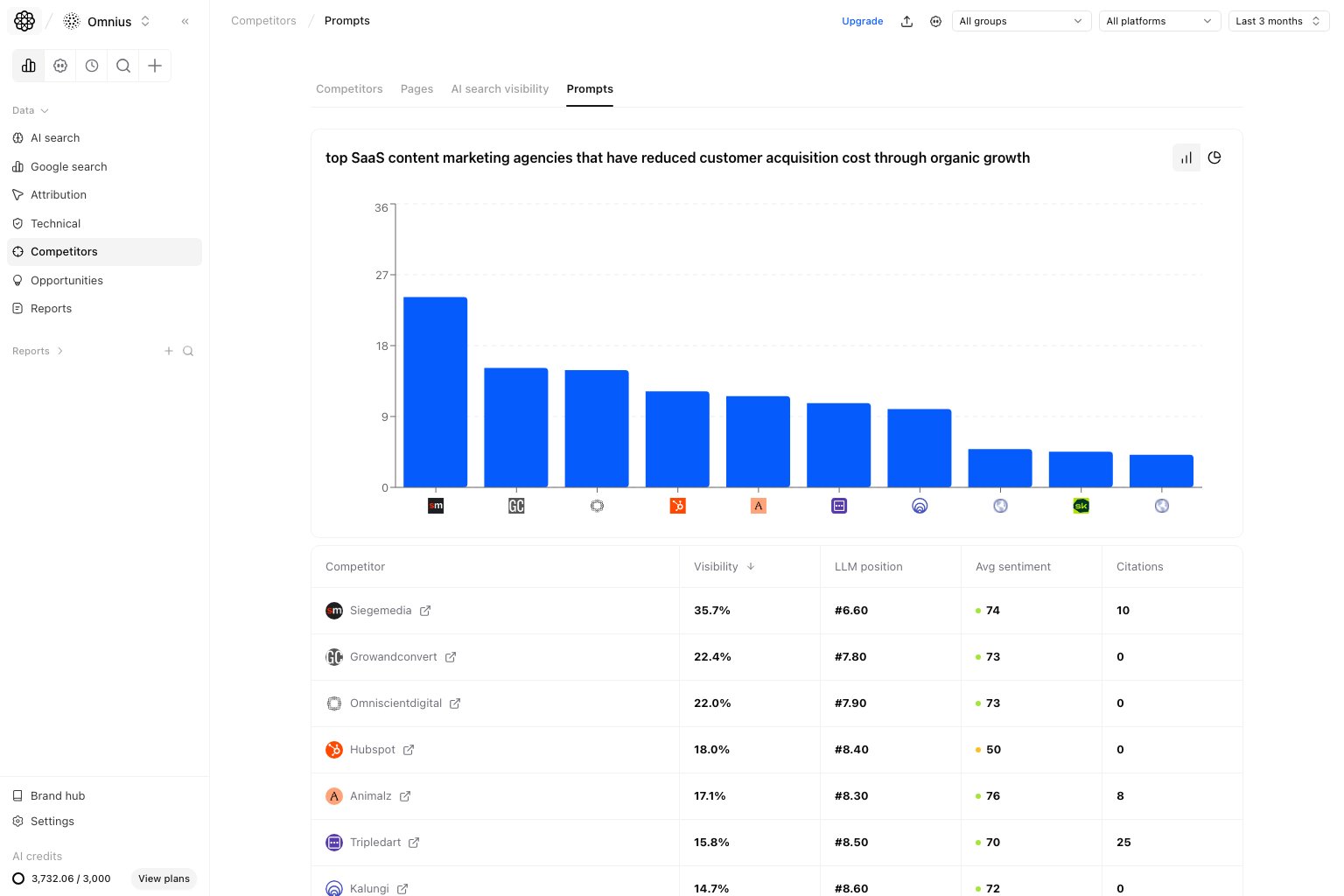
How to read the prompt comparison table
Start with prompt groups tied to business outcomes.Prompt: the tracked question or answer scenario.Competitor: the brand appearing or performing strongly for that prompt.Visibility/rank: how often and how prominently the competitor appears.Citation/support: the source evidence behind the answer when available.
- A loss on one prompt is a signal to inspect.
- Repeated losses across a prompt family are a strategy issue.
- A competitor win with strong citations usually needs proof and authority work, not just copy edits.
How these metrics are calculated (simple)
How to use this page
Start with business-critical prompts
Do not spread effort across every prompt. Focus first on the prompts tied to buying intent, comparisons, or product category definition.Separate message loss from authority loss
If a competitor wins prompts but not citations, your framing may be weak. If they win both, you likely need stronger proof and stronger pages.Turn prompt losses into focused work
One prompt cluster should lead to one concrete next action: improve a page, add proof, create a comparison asset, or strengthen external citations.Quick weekly checklist
- Filter to high-value prompt families.
- Identify repeated competitor wins.
- Check whether the competitor also has stronger citations.
- Decide whether the fix is page copy, proof, comparison content, or authority work.
- Create one task per prompt cluster instead of one task per prompt.
How to use filters
- Filter by competitor when diagnosing a known rival.
- Filter by prompt family or topic to avoid mixing unrelated intent.
- Keep date range aligned with AI Search Visibility and Citations.
What to fix first
Team routine
- Weekly: review top prompt losses on commercial themes.
- Bi-weekly: update content tasks based on repeated prompt clusters.
- Monthly: refresh tracked prompts and prune low-value questions.
Keep in mind
- Prompt-level losses are easier to act on than broad visibility shifts.
- Competitor wins on a single prompt matter less than repeated wins across a theme.
- This page is most useful when prompts are curated intentionally.