

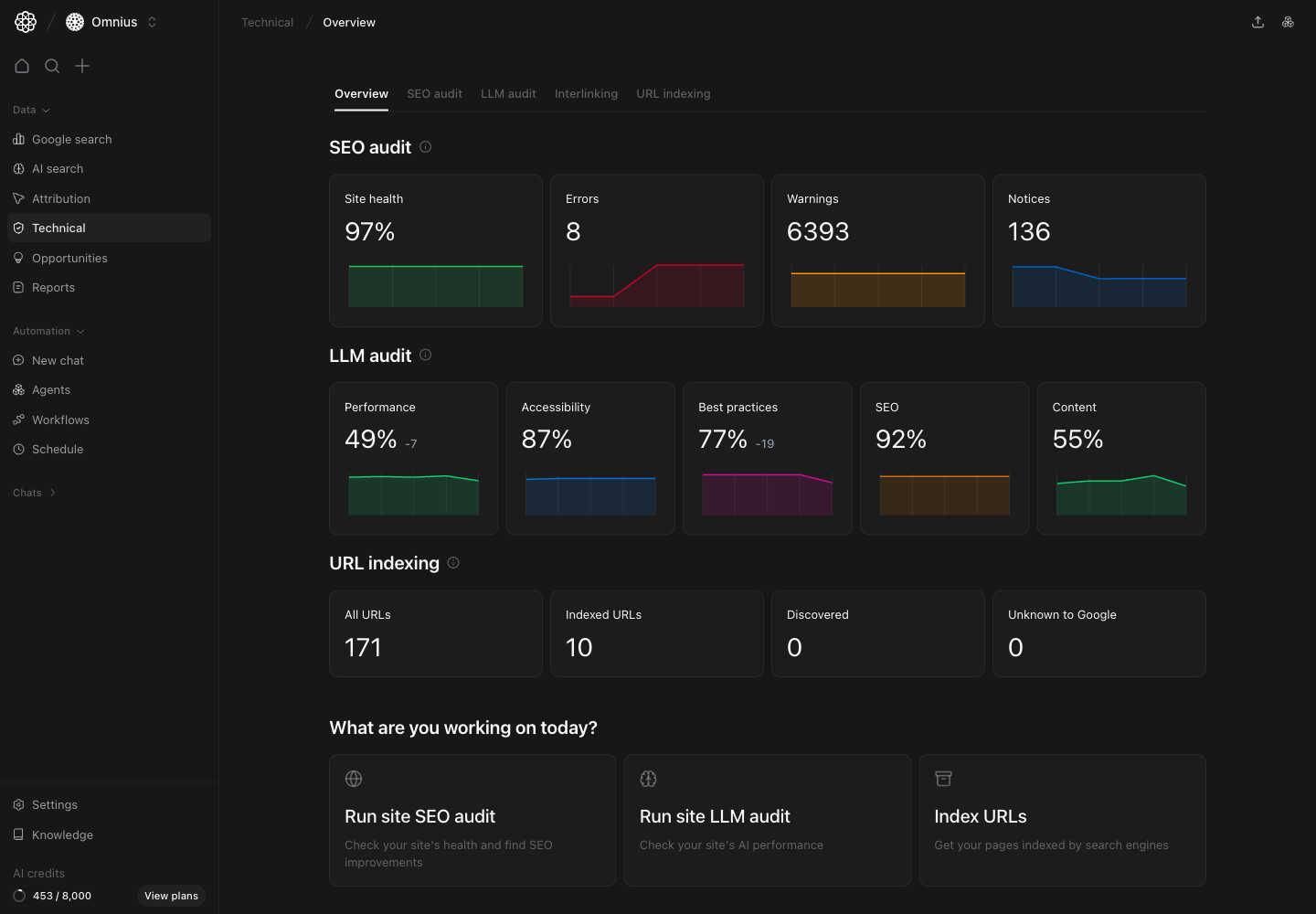
Important: Evaluate trend direction, not one isolated score snapshot.
Questions this page should answer
- Is overall site health improving or getting worse?
- Is the current risk mainly from SEO issues, AI-readiness gaps, or indexing problems?
- Which technical workflow should the team run next?
Before you analyze
- Keep the same date range you use in Search and Attribution reviews.
- Start with no assumptions and check all three blocks:
SEO audit,LLM audit, andURL indexing. - Compare current values with the prior period before assigning work.
What this page gives you
- A top-level snapshot of your technical health across crawl quality, AI-readiness, and indexing.
- Fast access to the main execution views:
SEO audit,LLM audit,Interlinking,Cannibalization, andURL indexing. - Action shortcuts so teams can launch technical work directly from the overview.
How to read the top cards
Read the overview blocks in this order:SEO audit: crawl health and issue pressure (Errors,Warnings,Notices).LLM audit: readiness for AI engines (Performance,Accessibility,Best practices,SEO,Content).URL indexing: discoverability and indexing coverage (All URLs,Indexed URLs,Discovered,Unknown to Google).
- If
Errorsare rising, start withSEO audit. - If
ContentorPerformanceis weak in LLM metrics, move toLLM audit. - If indexed coverage is low or unknown URLs increase, move to
URL indexing.
Key signal: Pick one primary technical workflow per review cycle. Parallel fixes across all three areas usually slow execution and hide impact.
How these metrics are calculated (simple)
Site health
LLM category scores
LLM category scores are weighted pass rates for checks in each category, shown on a0-100 scale.
Indexing status cards
Status cards are direct counts of tracked URLs in each indexing state.SEO audit section
This block shows whether technical SEO issues are controlled or spreading. What to watch:Site healthtrend direction.- Spikes in
Errors. - Large
Warningsvolume that can become future errors.
LLM audit section
This block tells you if your site is structurally ready for AI answer engines. What to watch:ContentandPerformancescores first.- Any category with repeated decline across audits.
- Gaps between classic SEO quality and AI-readiness.
URL indexing section
This block helps you catch discoverability problems before they hurt growth. What to watch:- Difference between
All URLsandIndexed URLs. - Any increase in
Unknown to Google. - Stalled discovery for new pages.
Quick weekly checklist
- Check all three blocks for direction change.
- Flag the single highest-risk area (SEO issues, LLM quality, or indexing).
- Open the matching detailed page and create fix tickets.
- Confirm owners and deadlines for critical technical fixes.
- Recheck trend change after updates are shipped.
What to fix first
Team routine
- Weekly: monitor technical direction and assign highest-risk fixes.
- Bi-weekly: review progress in each detailed Technical page.
- Monthly: report resolved issues and remaining structural risks.
Keep in mind
- A high health score can still hide critical issues in a few key pages.
- AI-readiness and indexing are not automatic by-products of classic SEO.
- Trends matter more than one-day values.