

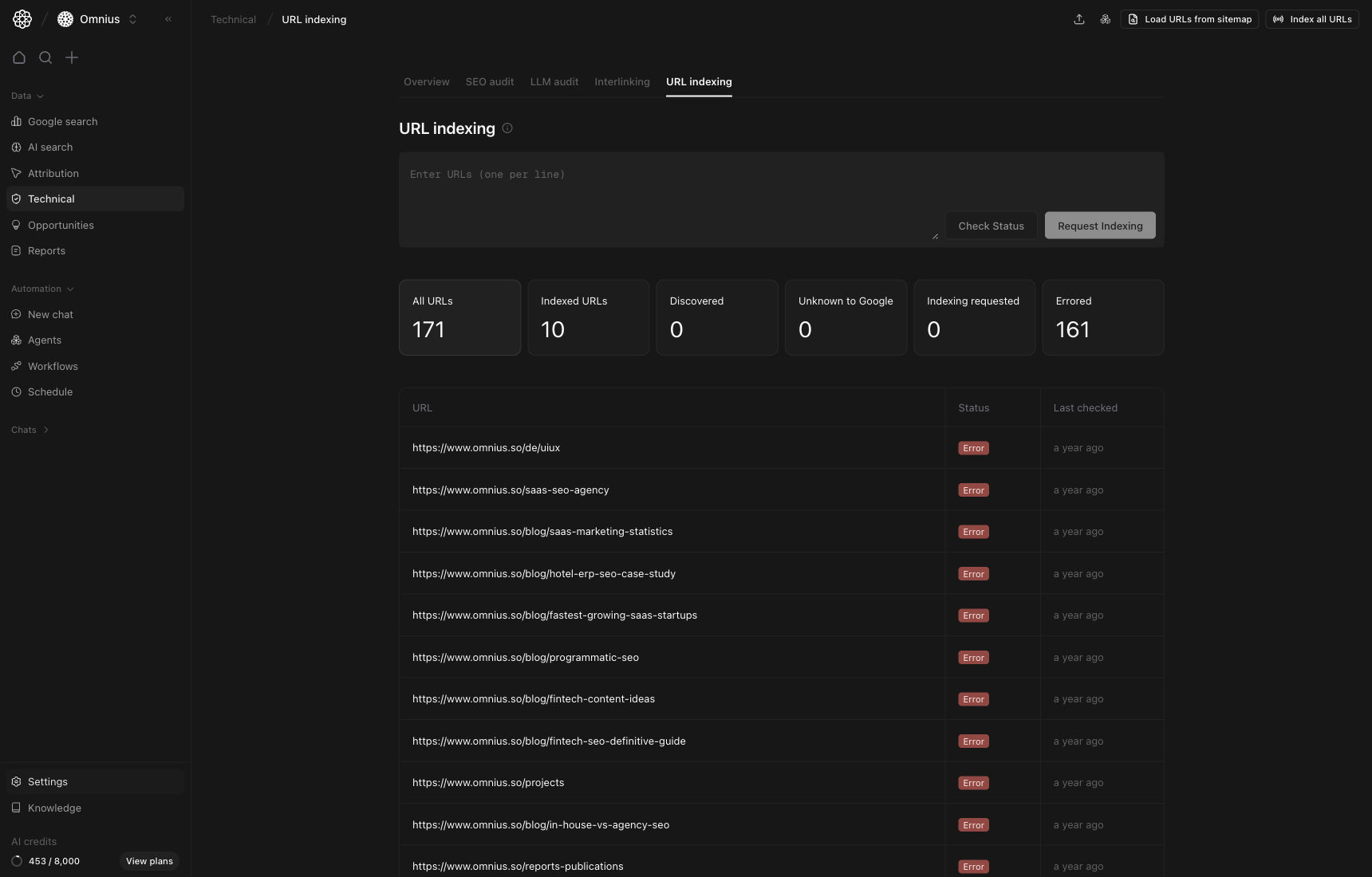
Questions this page should answer
- Are key pages being indexed correctly?
- Which URLs are failing indexing and why?
- Which indexing actions should happen first this week?
Before you analyze
- Start with high-priority page groups (money pages and key content hubs).
- Review status counts before checking individual URLs.
- Separate
Erroredpages from pages that are simply not yet discovered.
What this page gives you
- URL submission tools (
Check Status,Request Indexing). - Indexing status cards:
All URLsIndexed URLsDiscoveredUnknown to GoogleIndexing requestedErrored
- A URL-level status table with last-check information.
How to read the status cards
All URLs: tracked URLs in this project.Indexed URLs: pages currently known and indexed.Discovered: found but not yet fully indexed.Unknown to Google: not recognized in index checks.Indexing requested: URLs sent for indexing recently.Errored: URLs with indexing check failures.
- High
Erroredcount means direct indexing risk. - Large gap between
All URLsandIndexed URLsmeans coverage opportunity. - Rising
Unknown to Googleoften means discovery or sitemap issues.
How to use the URL table
Use the table to create an execution queue:- Sort and review failed URLs first.
- Group issues by path/template to find shared root causes.
- Check
Last checkedto avoid acting on stale assumptions.
Load URLs from sitemapto refresh candidate URLs.Index all URLsor targeted requests after fixes are live.
Quick weekly checklist
- Review status-card changes from last week.
- Triage
ErroredURLs first. - Submit fixed priority URLs for re-indexing.
- Validate status movement after recheck.
- Escalate repeated failures to engineering.
What to fix first
Team routine
- Weekly: index-status review and top-priority URL triage.
- Bi-weekly: investigate recurring failure patterns.
- Monthly: report coverage growth and persistent indexing blockers.
Keep in mind
- Indexing changes may take time after requests.
- Requesting indexing without fixing root cause rarely works.
- Priority should follow business impact, not URL count alone.