

Entities, clusters, pages, and funnel stages
- Entity: a subject identified in content, such as email deliverability. A passing mention is different from a page devoted to that subject.
- Cluster: a group of related topics and pages. A page can have a primary topic and secondary memberships; these do not contribute equally to validated coverage.
- Page: an individual URL with its own content, classification, and available performance measurements.
- Funnel: the stage of a buying journey served by a page. See Funnel stages for TOFU, MOFU, and BOFU examples.
Understand group coverage
For entity and cluster groups, coverage combines relevant owned content with Search Console validation. It is separate from whether every competitor intent has a matching page.
Current group validation requires at least three distinct relevant pages classified with at least 70% confidence, measurements for at least 80% of those pages, and at least 14 historical days ending before today. Entity relevance needs subject evidence in the title, primary keyword, or main headings; body mentions alone do not qualify. Cluster validation uses primary-topic pages.
For a 28-day period, at least two qualifying pages must each have 5 clicks and 100 impressions, with at least 50 clicks and 1,000 impressions across measured relevant pages. Traffic thresholds scale with the selected period. These are Atomic’s conservative product checks, not general SEO benchmarks. A newly connected site can be Weak because it lacks evidence, even when its content is useful.
Separate performance, trend, and planning
Performance describes measured organic activity. Insufficient data means metrics are unavailable or both clicks are below 10 and impressions below 100. Weak means at least 100 impressions with no clicks. Strong identifies pages at or above the eligible project’s upper-quartile click threshold when there are at least two eligible pages; other eligible pages are Healthy. A Strong page is strong relative to this project, not the entire market. Trend compares periods. Growing and Declining require at least a 30% change. The comparison uses clicks when the previous period has at least 10; otherwise it can use impressions when the previous period has at least 100. Stable is within that range. Insufficient data means there is not enough comparable evidence; it does not mean no change. Planning describes the linked task, not SEO success. Not planned means no linked task. Open, In progress, Blocked, Done, and Canceled describe work state. Open an existing linked task before creating another; Done does not prove that traffic improved.Data readiness
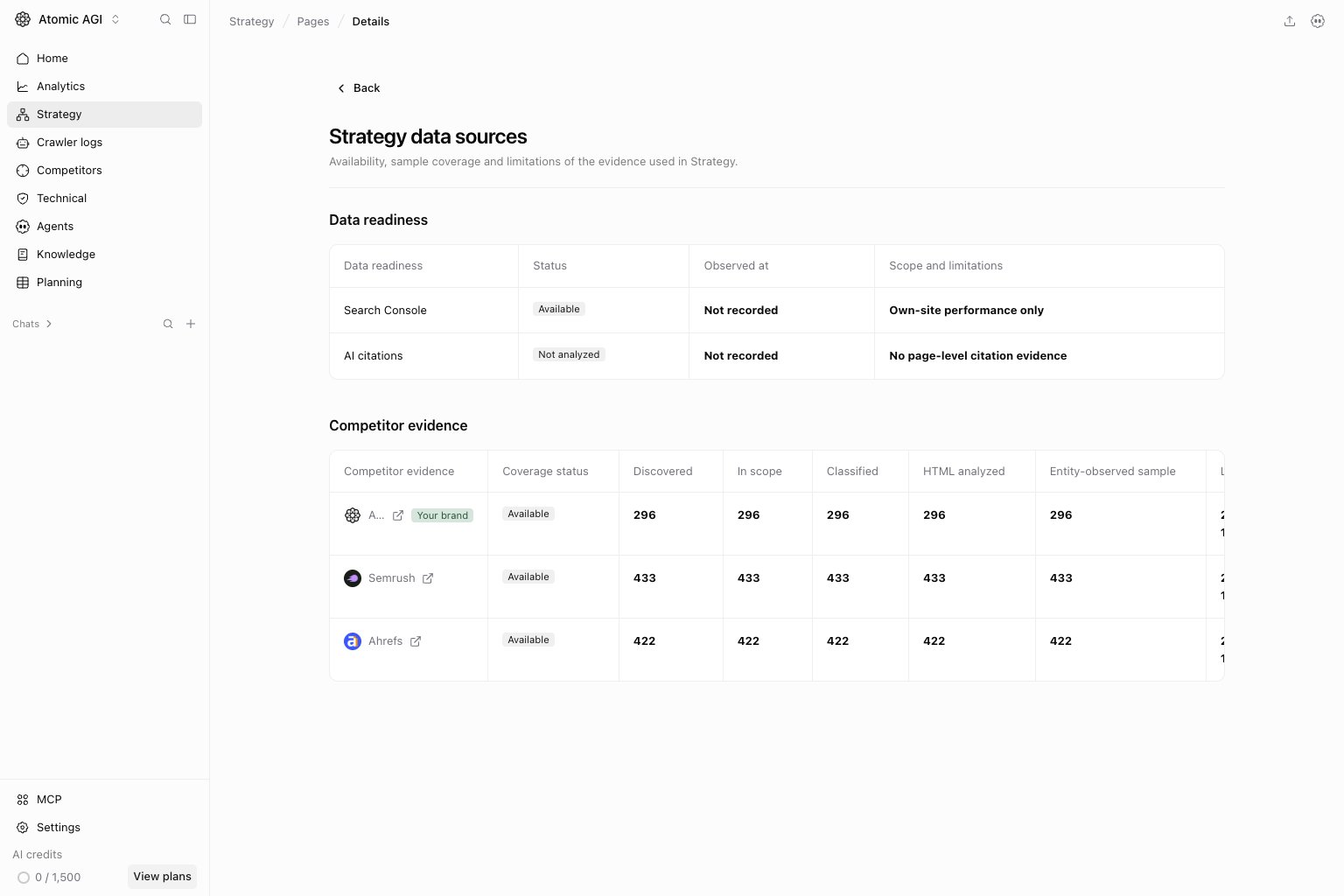
Check each source’s status, observation time, scope, and limitations. Search Console describes your own website’s performance. Page-level AI citation evidence may not yet be analyzed. Missing evidence should not be interpreted as zero performance or a confirmed gap.
Available does not mean exhaustive or live. A dash or unavailable result must not be interpreted as a measured zero.
Competitor evidence
The same URL can contribute to several counts; do not sum the columns. A large sitemap with few analyzed pages is not complete competitive coverage.
Use the last scan and evidence basis to judge freshness. Review the underlying competitor pages before committing to a topic or page format. Resolve missing connections or incomplete scans before making a large content plan.