

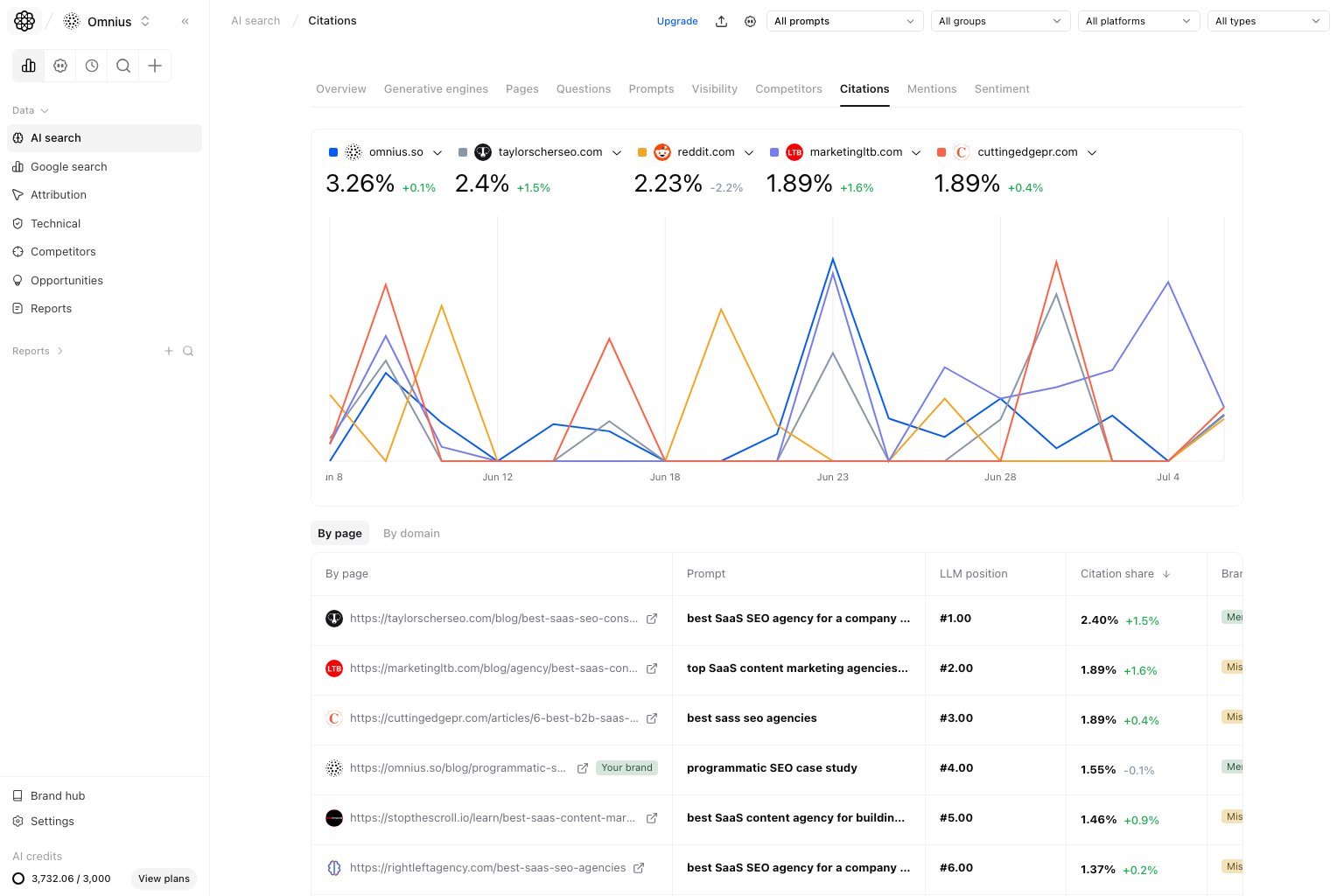
Important: Citation quality matters more than citation volume. Prioritize trusted domains that influence decisions.
Questions this page should answer
- Which domains are getting citation share in our topic space?
- Is our brand cited enough on strategic prompts?
- Where should we build authority first?
Before you analyze
- Keep date range aligned with Visibility and Competitors.
- Start with all prompts and all platforms.
- Then segment by citation type and platform.
What this page gives you
- Citation-share trend across top cited domains.
- Ranked citation table with prompt context.
- Two subtabs:
By pageandBy domain.
How to read the top citation trend
Avg. share: average citation footprint.Rank: relative placement in citation results.Type: source class (You,Competitor,Editorial,UGC, and others).
Key signal: If competitor citations rise on strategic prompts while your share stays flat, authority is shifting against your brand.
Example: You can keep visibility on a prompt while losing citation share. That usually means you are still mentioned, but trusted sources are increasingly backing competitors.
How these metrics are calculated (simple)
Avg. share
Rank
Rank is the ordering after sorting byAvg. share (rank 1 has the highest share).
Type
Type is a rule-based source classification (You, Competitor, Editorial, UGC, and others).
By page tab
Use this tab for URL-level citation diagnosis.- Competitors are repeatedly cited on important prompts.
- Your page appears but with low share.
- Citation type is weak for a high-value query cluster.
By domain tab
Use this tab to evaluate domain-level authority distribution.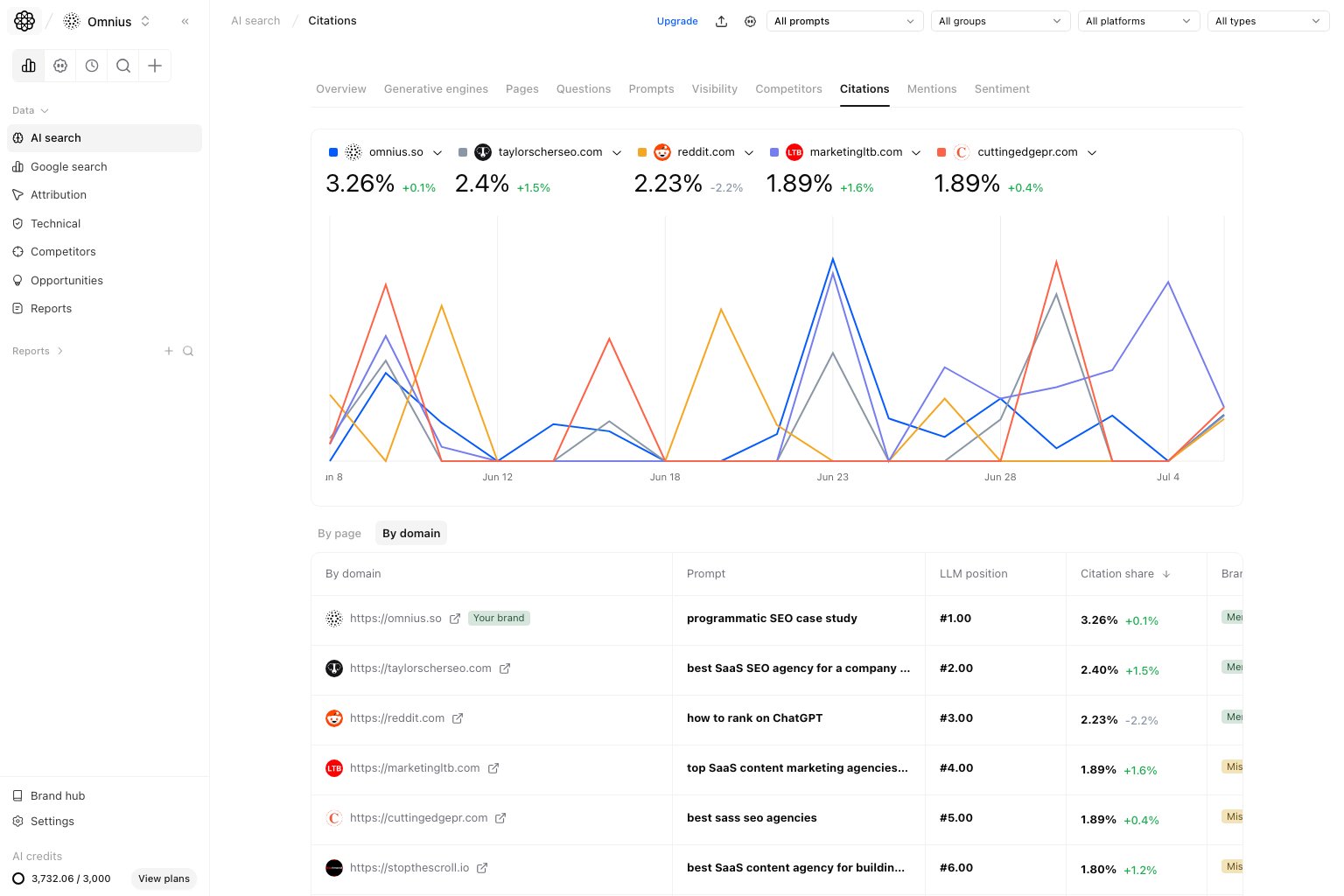
- Separate durable editorial authority from lower-signal sources.
- Identify domains where your brand is underrepresented.
- Plan outreach and evidence content by domain priority.
Quick weekly checklist
- Track top citation winners and losers.
- Compare your brand share by page and domain.
- Flag prompt clusters with weak source support.
- Assign one source-authority action.
How to use filters
All prompts: isolate strategic prompt groups.All platforms: compare source behavior across engines.All types: focus on source class (Editorial,UGC,You, and others).
What to fix first
Team routine
- Weekly: monitor citation share changes.
- Bi-weekly: review source-type quality mix.
- Monthly: report citation progress on strategic prompts.
Keep in mind
- Citation quality matters more than raw citation count.
- Authority changes often lag content publication.
- Domain-level wins are usually more durable than single-page wins.